
Jun 23, 2025 12:17 AM
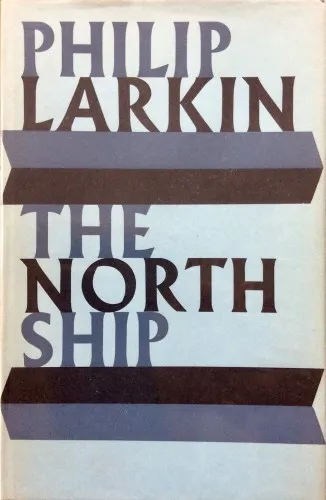
Having first got to know Larkin through his classics (principally The Whitsun Weddings with its almost wall-to-wall bangers), his debut collection The North Ship feels both strange and familiar. The same subjects are there: sexual frustration, yearning for unobtainable women, despair, nihilism. "XVI", for instance, feels like an exact forerunner of "Aubade", perhaps his crowning masterpiece:
The bottle is drunk out by one;
At two, the book is shut;
At three, the lovers lie apart,
Love and its commerce done;
And now the luminous watch-hands
Show after four o’clock,
Time of night when straying winds
Trouble the dark.
And I am sick for want of sleep;
So sick, that I can half-believe
The soundless river pouring from the cave
Is neither strong, nor deep;
Only an image fancied in conceit.
I lie and wait for morning, and the birds,
The first steps going down the unswept street,
Voices of girls with scarves around their heads.
Fretful wakeful dissatisfaction, fear of malignancy in nature, the sudden step out from the poet's feelings to the indifferent bustling of the world. . . it's all there in embryo. And the differences are illustrative. The circle of Larkin's subjects may not have enlarged but his technique certainly changed. The symbolist mode, which is frequent in The North Ship ("The soundless river pouring from the cave...") is almost totally absent from his mature work. And he managed to free himself from writing in a self-consciously poetic register ("an image fancied in conceit"). I'm a huge fan of lofty diction myself but it's always a little arch and affected in early Larkin:
What if it has drawn up
All quietness and certitude of worth
Wherewith to fill its cup. . .? ("III")
To wake, and hear a cockOut of the distance crying. . . ("IV")
Is it a trick or a trysting-place,The woods we have found to walk? ("XXVIII")
Not absent from his later work, but heavily modulated, is nature poetry. I had no idea how Yeatsian (and through Yeats, Keatsian) this collection would be. There is a proliferation of beasts and skies and seas—always sailed upon by rigged, not motoring, ships—out of which the poet mines feeling:
All catches alight
At the spread of spring:
Birds crazed with flight,
Branches that fling
Leaves up to the light—
Every one thing,
Shape, colour and voice,
Cries out, Rejoice! ("I")
And it's good but not natural. There's always something stilted ("Rejoice!" above); and the absence of anything that clearly belongs to the poet's own time and place feels like he has a blindspot, hasn't yet developed the wide sympathies that let the mature Larkin write sublime poetry about waste paper baskets ("As Bad as a Mile") and advertising hoardings ("Sunny Prestatyn"). Larkin was raised in bombed-out Coventry, not under Ben Bulben, and at this stage he needed to grow into what was really in his bones and out of the shadow of his influences. There is one tantalising hint of this future growth, which will culminate in "Here" and "The Whitsun Weddings", his magnificent lyrics that take in nature and the modern city in a single sweep:
Waiting for breakfast, while she brushed her hair,
I looked down at the empty hotel yard
Once meant for coaches. Cobblestones were wet,
But sent no light back to the loaded sky,
Sunk as it was with mist down to the roofs.
Drainpipes and fire-escape climbed up
Past rooms still burning their electric light:
I thought: Featureless morning, featureless night.
Misjudgment: for the stones slept, and the mist
Wandered absolvingly past all it touched,
Yet hung like a stayed breath. . . ("XXXII")
And there are two poems of finished excellence. First, the epigram "XXVI", which cannot be read without being learned (the soundest test of poetry):
This is the first thing
I have understood:
Time is the echo of an axe
Within a wood.
Second, the break-up poem "XXIV":
Love, we must part now: do not let it be
Calamitous and bitter. In the past
There has been too much moonlight and self-pity:
Let us have done with it: for now at last
Never has sun more boldly paced the sky,
Never were hearts more eager to be free,
To kick down worlds, lash forests; you and I
No longer hold them; we are husks, that see
The grain going forward to a different use.
There is regret. Always, there is regret.
But it is better that our lives unloose,
As two tall ships, wind-mastered, wet with light,
Break from an estuary with their courses set,
And waving part, and waving drop from sight.
I like to think of this as Larkin's farewell to the juvenile poet he then was. Too much moonlight and all the other natural mainstays of poetry: now for mastery of the colloquial, from "kick down" onwards.
8 Comments
6 months ago
I really enjoyed reading this review. It's been ages since I looked at Larkin's earlier work, but what strikes me in the bits you quote is the influence of Auden. I mean you can hear Auden in all Larkin's work, but it's kind of self-conscious here. The Whitsun Weddings might be my favorite single collection of poetry.
6 months ago
Chuffed to hear it! Larkin mentions Auden in the introduction as his main alternative to 'traditional' poetry when he was in his teens. I don't pick up on it because I've read almost no Auden at all but I believe you; the echoes of Yeats and Keats (and Housman now that I think of it) are really overt.
6 months ago
Yes, Housman is in the same lineage. They all share a kind of phlegmatic Eeyore mindset, a very English sense of fading or faded grandeur, of decline punctuated by moments of beauty (or maybe even beautiful in itself). You can hear it in Elgar's cello concerto too.
6 months ago
Well put and an apt comparison. Coincidentally, I'm typing this about 200 yards from a building named after Jacqueline du Pré. I'm a sucker, English as I am, for anything with that "days that are no more" quality.
6 months ago
I'm English too, it's definitely in the national character. '66 and all that. I mean people everywhere hark back to fonder times, but the English do so indulgently, in a knowing way, taking pleasure in the actual "algia" part of nostalgia.
6 months ago
Ah, nice. If you're ever in Oxford or London (I divide my time) and want to get a pint, drop me a line.
6 months ago
Cheers! And same to you if you're ever in or near Vancouver (I get to London every couple of years or so).
6 months ago
I've got a friend at UBC who I'll probably visit in the next year or two!