
Nov 17, 2024 8:52 PM
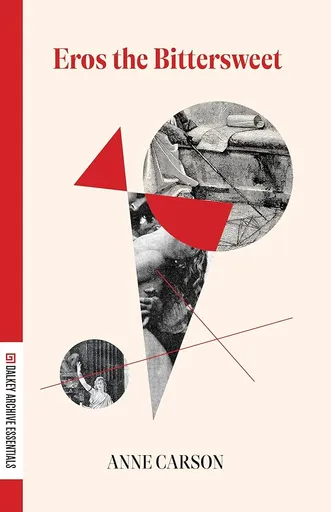
*Eros the Bittersweet* belongs to an entirely different genre of literature. Or, it belongs to pre-genre literature, before modern taxonomies were foisted on us. There was once a time, I have read, that the terms "Greek Literature" and "Latin Literature" referred to all extant texts in those languages. So Plato's dialogues were placed in the same category as Sophokles' dramas and Aristotle's forays into biology. Likewise for Cicero, Vergil, and the graffiti at Pompeii. The best scholarship was thus wide-ranging and sought to understand an idea from many perspectives.
Given that Eros the Bittersweet is a reworking of her classics dissertation, it seems like Carson came from that time, if it indeed existed. Or, at least, you get the sense that you are reading something far beyond a text written to satisfy the demands of a sterile, circumscribed academic press. Reading Eros the Bittersweet, you will think, "They don't make 'em like this anymore." But they do. Carson is still alive, as far as I know.
Her subject in the book is ostensibly the role of eros--love or desire--in ancient Greek literature and philosophy. But there is not a clear thesis of the form "*Eros* plays such-and-such a role in so-and-so's poetry." Carson does not offer propositional knowledge.
Instead, the book is a sort of essay in the original sense of the French essayer, to try. Essays are attempts to grapple with an idea or concept, and they may or may not come to firm conclusions. Carson grapples with eros, aided by ancient writers acting as partners in dialogue. One gets the sense that Carson is not so much trying to convey what eros was to the Greeks, but what eros is.
What is eros, then? Eros is romantic love that is "bittersweet," as Sappho wrote. It is pleasurable because it is painful. We want it because we cannot have it. is "the experience of melting." If two people are in love, is the gap between them. is paradox and metaphor.
If all of this sounds hokey and ill-defined, well, it is. More rigid, analytic attempts to define romantic love would be even more unsatisfactory. But Carson treats the subject is such a way that--to borrow a literary cliche--you discover what you already know, which is the purest sort of knowledge.
Lyrical, erudite, and witty, Eros the Bittersweet defies summary. Like all that is best, it cannot be explained, only experienced. As I read it, I thought "there is something vitally important here." Maybe even important enough to learn Greek.
1 Comments
1 year ago
The main thing I got from this book was the greatness of Sappho. I kind of enjoyed Carson’s peregrinations but in the end they seemed academic to me, compared to the immediacy of her source text. But I agree, it’s a blast as lit crit goes, up there with Gass’s stranger forays.