
Feb 2, 2025 9:35 AM
American Psycho gets away with being one of the most didactic social satires ever written by also being one of the most rigorous. Every element of the social fabric is covered: Wall Street yuppie consumerism, intensely hollow interpersonal relationships, could-be-lame potshots at 80s popular music, designer brand obsession as a replacement for the human visage, restaurant culture (what you order, why you order it, pride of placement w/r/t seating, the social game of which restaurants are 'in', the power game of reservations), you get the idea. It's a form of tedium that sucks you into itself; you can feel the layers of your soul being stripped away by the tourism brochure dialogue and endless scheduled mundanity. You can understand how a Bateman comes to be. It also, ingeniously, leaves you completely unguarded for when the grotesque ultraviolence takes hold. I defer to the second chapter of Blood Meridian, a book with a reputation for disturbing violence but one wherein the mass and thoughtless genocides contained thereafter never dug as deeply into me as the kid expertly and cleanly vaulting over the bar, carefully selecting two bottles, breaking one over the bartender's head, passing the other from one hand to the next, backhanding the bartender with it, and then sticking the remnants of the bottle into his eye. It is the intimacy of this scene, the intentionality and competence behind his actions, that disturb me. 's violence is uniformly as intentional and intimate, though far more graphic. On that note, despite being the only book I've ever seen in a walk-in West Australian bookstore to be wrapped in plastic and stuck with an R18+ sticker, I was still caught off guard by the first attack of the book. The visceral pop of the eyeballs, the thunderous crunch of stomping on the dog's front legs; these images haven't left my head since reading it, though they have been joined by the even fouler scenes contained to the book's back half.
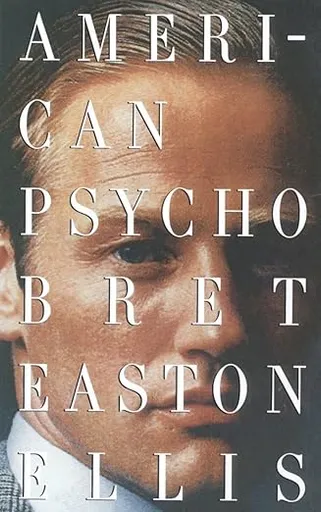
I think now, with most first-time readers (myself included) having seen Mary Harron's film adaptation first, this book might even be more interesting. Both are overt and unsubtle condemnations and contain mostly the same core events in the same order, but the opposing authorial perspectives completely reshape the tone of the pieces. Bale's Batemen is an alien, a human-shaped creature that visibly can barely contain its confusion and loathing at everything it sees. As a result, he, and by extension, the film, become a cartoon, out-and-out cinematic farce. Take the infamous business card scene, the intensity with which Bale holds the tiny paper, the veins popping in his forehead, vibrating with anxiety, and then the delivery of "it even has a watermark" (a Harron addition); it's so pathetic it's hilarious. This scene is still funny in the book. As a matter of fact, the entire thing is funny, just in a more wry, deadpan register. But without being paced or delivered like a joke, with the weight of every other piece of life-defining emptiness, it becomes so pathetic that it's pathetic. I don't exactly feel bad for the guy, but he seems partially human, a husk that contained at least the possibility of a spark of life at one point or another, a creature born of a desperation to fit in. The self-fulfilling narcissism of this world has painstakingly modelled the evil gnawing at it from within. The degradation of the soul, society's and Bateman's, happens in slow motion, the final act surrealism reflecting a total loss of the self. This also happens in the film but, call me old-fashioned, never as effectively as in the book's brief spill into third-person narration.
Is this divergence a question of the contrasting strengths of the two art forms? Is this a matter of female vs. male gaze, a story of masculinity in crisis seen for the absurdity it is by the woman who would adapt it? Is it as simple as Ellis having less personal (and chronological) distance from the subject matter than Harron? Is it all of the above plus one million other things? Yes! Of course! But that's what makes them so valuable as companion pieces. It's so wonderful that one of the era's most vivid satires has the added texture of a just as (more, even?) famous adaptation that is both in agreement with it and hostile to its approach.