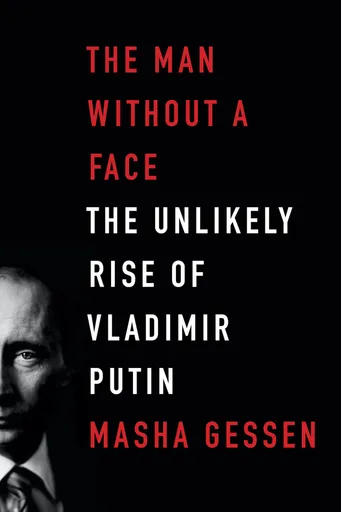
I found this book in a little free library and picked it up as part of my collection of caricatures of Putin crafted for americans.
Masha Gessen is a russian-american dissident and this book has the same problem russian dissidents like Solzyenitzen or Trotsky had with their books on Stalin; the grudge is so personal that the author is (understandably) incapable of writing about them without a feelings of contemptuous outrage.
More reviews
But. this outrage clouds the author's vision, and instead of trying to say something insightful about the individual, they instead settle for making their subject as unlikeable as possible. Some of it seems like Gessen is trying to annoy the faraway enemy who will never read their words, especially since it's such foreigner-focused fare that Gessen didn't even bother making the text available in Russian. So much for samizdat!
To be clear, I am not saying that Putin is a cuddly humanist or simply a patriotic genius doing only what he has to in order to serve the Russian people. He's certainly no stranger to skullduggery, thuggery, and all the corruption and lies that power seems to invite if not outright require.
So how odd that we discover that Gessen's Putin, like Trotsky's Stalin, is a completely uninteresting, mediocre, unintelligent, who has only base and vile instincts and crude notions which never change. There is no external explanation or structural forces at play, no internal coalition of interests to balance, no playing of the game well on the way up, and no proficiency in creating and maintaining the institutions of a non-democratic state. It is instead all just chance, because any other explanation would require a concession that perhaps Putin has a little spark of something in him, at least some kind of differentiator that marks him as a strategic thinker.
Stephen Kotkin, an exemplary historian who has written two excellent, authoritative volumes on Stalin (and who loves his family so much he is willing to humor the vile cretins of the Hoover Institute) is quite vocal about this persistent shortcoming in Russian dissident literature. It is true that figures who rise to the top in brutal times and places are often not geniuses, often ignorant of certain things, often make large mistakes, and may be possessed of a certain idee fixe which gives them political salience but limits the horizons of their analysis.
But in reality, there are no authoritarian Mr. Beans who fall ass backward into greater and greater personal power for decades by sheer accident, and all such stories do not hold up well under close examination, or any examination. Someone who has maintained power and has at the very least managed russian crisis and decline far better than his two predecessors can be many things, but is not a non-entity, a grey blur, or an outstanding mediocrity. Someone who has no skills may have the position of head of a great power fall into their lap, but they will not be able to rely on luck to hold onto it for very long.
So, these kinds of poison pen narratives from resentful intellectuals can attain fleeting popularity as longform insults, but they never hold up as enduring insights about the person, the regime, or the nature of human character.
This is the kind of book that ends up revealing much more about the neuroses of the author than the subject, since Gessen frequently stoops to confabulations and forms of schitzoid "objective knowledge" about the inner feelings and motivations of someone else.
No evidence is required, since it's written in English and you heard about it in the New Yorker and therefore we're all on the same team so it would be gauche to notice how sloppy and fantastical the editorializing can get. Gessen is not shy about writing things like:
"Putin felt an uncontrollable rage in that moment when he left the meeting, because the Soviet Union he loved so much without any nuance whatsoever was being denigrated, and he refused to accept the reality of its evil, the way he had refused to accept the reality of his own limited intellectual capacity his entire life."
I'm exaggerating of course, but less than you would think! It's rather like reading Tolstoy as if it was written in the style of Ayn Rand, which is less than ideal for a biography of a living head of state.
More charitably, this could have been less embarassing as "creative non-fiction" or "using imaginative inferences to fill in the gaps", but this isn't her fucking MFA thesis, it's presented as if it's Serious Journalism. It is not.
You can see this even in the constructions of sentences and the choice of technique: Gessen breezily crosses from biographical nonfiction into hatefic where she gets redefine all the characters and recontextualize all the historical events without needing any evidence or pesky statistics about plunging life expectancies and looting of the country by her heroic democratic friends. I was going to snarkily call out some illusions, but there is also some genuine pain in there, and she's not like someone who went down some kind of QAnon/BlueAnon hole from the comfort of suburbia and is frothing with rage about distant events which are invisible in their daily life and entire biography.
Gessen is truly Russian, truly tried to return to Russia and participate in its civil society from the 1990s to 2013, and some of Gessen's friends and colleagues really were shot in stairwells, imprisoned, driven into exile, and mysteriously fell off fire escapes. Resistance from a posh St. Petersburg apartment is still resistance, and while I have to be honest about finding her writing to be dishonest, histrionic, and intellectually lazy, I have genuine respect and sympathy for her experiences.
And hey, maybe if they (plural, not non-binary) were paying me six figures to write propagandistic slop for impossibly ignorant liberal arts majors who have no idea that their empire is evil too, even when the president seems cool and says the right empty words, maybe I'd loosen the fuck up and start cashing some book advance checks for my incisive journalism in the Atlantic:
"Donald Trump walked down the hall racistly, filled with hatred for the female scientists who had always intimidated him." Loft apartment in Manhattan, here I come! But I digress.
It is ironic that both Putin and Gessen are orthodox economic liberals who support and have been supported by corrupt oligarchs, who do not trust the Russian masses with democracy, and whose disagreements are about which set of criminal bandits should impose their cultural-political program upon a stubbornly immobile and still-traumatized russian society that remains itself; authentically radical, authentically conservative, authentically hopeful and humanistic, authentically cynical and selfish.
We can say Putin is opportunistic and a touch evil when he misrepresents and suppresses key aspects of the Stalin era for personal political gain, but Gessen is no less opportunistic and evil when she does the same thing for the Yeltsin era.
It is this dual understanding that has made me totally unemployable within an anglo-american/western-european/russian context, bereft of any audience or even academic advisors willing to be associated with me during that beautiful post-financial crisis time. What a time it was, where roving professors in europe who needed well-compensated jobs and nubile international students to bed were desperately trying to find a way to justify taking money and talking points from the CIA and neocon institutions while still being liberal-marxist-radical-democrats who Live In Truth.
But this review must come to.a close, it risks becoming everything I despise: writing about the reviewer and the author, and not about the fucking words on the page and how it feels to eat the course they've laid out for you. It feels like two pieces of bread with a tiny slice of spam, it feels like reading a livejournal post about a middle school ex that never tires of reminding you of how much he sucks even when talking about his childhood.
I skipped over the sections I already knew from other, better books. But in general, what was true and defensible was not new, and what was new was not even "not true" but simply unfalsifiable, unflattering interior speculations which at times felt obsessive.
I took it out of the little free library as a service to the public, but I think I'll have to use it as kindling for my next campfire as I would be embarrassed to have it recognized on my bookshelf.
Imagine how awkward it would be for everyone at one of my dinner parties if someone's unvetted new-yorker reading and likely fat-ankled +1 were to notice it and heap praise upon the non-binary author's incisive and prophetic analysis.
No, better for that one to to gaze cow-eyed upon my shelves until they at last get to a nearly pristine copy of the Three Body Problem gifted to me by a distant relation.
"That's my favorite sci-fi book, it's so scientifically accurate," she says, waiting for my rote validation. "Mmm-hmmm", I'll murmur, politely hiding my sneer with a deep sip of piping hot gluhwein.
I am not saying that every copy of The Man Without A Face should be burned, but for me, a man with a face of easy smiles and eager creator of bonhomie around a crackling blaze, it's the right choice.