Nov 12, 2025 1:31 AM
I've had a slow approach to Eliot, but what finally got me on the train (though like everyone I've always liked Prufock) was an almost idle decision recently to memorize the first section of The Waste Land, which deepened my appreciation for the poem's demotic language, its orchestration of dense internal references, the apparently unmotivated shifts between voices. Then, helped by my and Eliot's mutual love for Dante, I came to appreciate Ash Wednesday just as much (maybe even more).
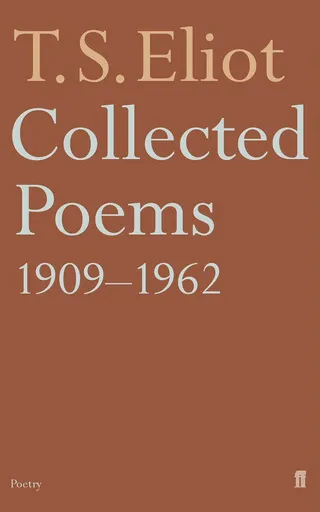
All to say I had a pretty shallow acquaintance with Eliot coming in: all the famous stuff except for the Four Quartets. But he also wrote other poems, all collected here. The natural question: are any good?
Answer: I don't know. The only judgements I can feel confident about making are that the "minor poems" are indeed minor and the "occasional verses" feel pretty wobbly but that Eliot in a comic mode is always enjoyable, and that I miss that tone in some of his later poems, where it crops up far less often. As for anything involving Sweeney--Sweeney Erect, Sweeney Agonistes--man, I have no fucking idea.
The Four Quartets are the real difficult test case for me. Many parts are wonderful, beautiful, imagistic, hymn-like--"The only hope, or else despair / Lies in the choice of pyre or pyre / To be redeemed from fire by fire."--and then there are parts that seem to be a little sententious or formulaic, like a guy turning St. Augustine into stately iambic pentameter. Is that unfair? Almost definitely. But I guess I can't help that I'm a 21st century atheist and not a 20th century Anglican, and I like the cut-up, corrugated texture of the Waste Land more than the poetized ratiocination of (some of) Four Quartets; between both, Ash Wednesday hits the perfect balance for my taste. Maybe I'll learn to like (or, with annotations, understand) this Eliot more in the future.
One thing reading these poems all the way through does do is put The Waste Land in a different light. You see that Eliot was always reworking certain images or turns of phrase: the "Death by Water" section actually appears in an earlier poem (in French!) and then its phrase, "the profit and the loss" reoccurs in Ash Wednesday. And Gerontion was supposed to be the first part of The Waste Land, but Ezra Pound convinced Eliot to cut it. These cross-references and the use of the same techniques suggest something of the mystery of Eliot's popularity: there was something about that one poem he wrote that struck lightning with the public and became the emblem of "modernism," and reading this collection--seeing there's a before and after to that lightning strike--makes you appreciate it for the weird, weird, weird text it is.