
May 10, 2025 2:36 PM
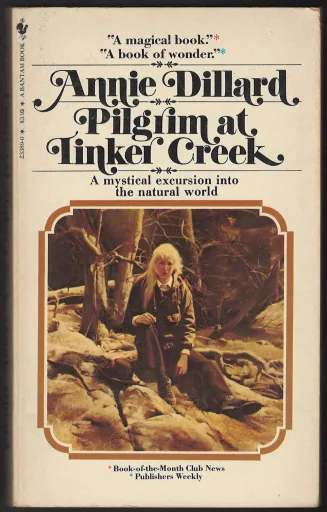
A Pilgrim at Tinker Creek is a nice piece of nature writing that is more immanent than transcendentalist in its sentiment; a work more in line with Heraclitus and Dogen than Plato, Emerson, or Thoreau. Dillard strives to appreciate the beauty in the brutality of nature, moving from a scientific understanding and going down into nature, frolicking through the pond scum and detritus to find the beauty in sexual cannibalism and parasitic matricide.
There's a sort of cringe cliché of associating authorship and expression of ideas as equivalent to childbirth. It goes back at least to Plato and Socrates. Socrates called his method of questioning the maieutic method, likening himself to a midwife drawing out ideas. In one of my favorite passages, Dillard subverts this sentiment with an example of ichneumon wasps:
You are an ichneumon. You mated and your eggs are fertile. If you can't find a caterpillar on which to lay your eggs, your young will starve. When the eggs hatch, the young will eat any body in which they find themselves, so so if you don't kill them by emitting them broadcast over the landscape, they'll eat you alive. But if you let them drop over the fields you will probably be dead yourself, of old age, before they even hatch to starve, and the whole show will be over and done, and a wretched one it was. You feel them coming, and coming, and you struggle to rise...
Not that the ichneumon is making any conscious choice, if she were, her dilemma would be truly the stuff of tragedy; Aeschylus need have looked no further than the ichneumon. That is, it would be the stuff of real tragedy if only Aeschylus and I could convince you that the ichneumon is really and truly as alive as we are, and that what happens to it matters.
To what extent are we compelled by ideas to disseminate them? To foist them on others lest they consume us. Or are we the caterpillar? Dillard immediately follows the passage above with an example of caterpillars that go into a molting frenzy, where they don't completely shed their carapace, molting within their own husks, smaller and smaller until they die. At some point ideas need to be expressed and passed on even if they're not original to us, even if they're antithetical to some part of us.
Dawkins published the Selfish Gene in 1976. In it he coined "meme" as a neologism for ideas and behaviors that replicate and evolve in a manner similar to natural selection. Dillard published Tinker Creek two years prior. But with regards to both of them, memes (from the Greek mīmēsis) and the idea of memes are nothing new.