I picked this up simply because the plot of future technocrats attempting to colonize Greenland felt timely, but this is some of the best speculative fiction I’ve read: surpassing Dune in strangeness and literary merit, Frankenstein in its themes, and at least equal to The Book of the New Sun in its allusions, symbolism and prose.
This novel feels as if Joyce tried his hand at weird fiction or horror, as if fertility gods walked through Disco Elysium, or if Clark Ashton Smith was capable of writing something more than 50 pages.
Alfred Doblin’s novel spans the imagined future of the 21st to 27th centuries. Entire sections are dedicated to sweeping descriptions of political movements, technological innovations, Malthusian anxieties, mass displacement. Punctuating the historical prose and zooming in on more specific events are scenes of technocrats, oligarchs, scientists and their enemies. These are all mythic and almost religious in tone.
Take for instance this introduction to one tyrant, reminiscent of the Illiad’s opening lines:
HOW SHE rampaged, Melise of Bordeaux!
This female, in whose veins black African blood flowed mixed with the zones of Italy and western France, overturned every agreement reached by the spineless childish people around her. She saw how people delivered themselves to pleasure and grew soft and softer and surrounded themselves with a likeminded clique. She was of a savage passionate sensuality that was at the same time cold and repellent; she herself suffered. She coiled around her lovers, male and female, like a giant snake, crushed them until she was sated, left them lying frightened there. No one ever knew when she was in earnest, this crinklehaired thicklipped woman with glittering black eyes, who wept often and loudly, bemoaned herself and her fate. She cried like a drunkard, melodiously without depth, ending in a graceless laugh of vexation. She induced every clan in her townzones to hand their most important weapons and installations over to her followers. She destroyed a number of installations, not knowing how to make use of them and so deeming them superfluous. Soon she distinguished two categories of townzone over which she exercised dominion: pet-zones and slave-zones.
And it’s not just tone, these characters have a symbolic connection to gods and ideals. Melise has citizens brought to her, judges them and (perhaps not entirely metaphorically) consumes them. She comes to identify herself with Persephone and her realm with the underworld. In a series of events highly reminiscent of the Akkadian goddess Ishtar’s descent to the underworld, a girl by the name of Betise is stripped, brought before Melise, impaled, and imprisoned. Betise will eventually flee with hunters in pursuit, much like Ishtar fleeing Ereshkigal’s demons. The mythemes aren’t a one for one analogy to Doblin’s epic, but the components are there to identify Melise with death overtly, and Betise with nature and fertility implicitly.
Melise’s fickle abuses are quickly walked back and promptly replaced with love-bombing apologies, as if she can’t help but brutally punish what she adores for being other and ultimately uncontrollable. It's as if technological society is impetuously lashing out at nature for not bending to its will. But Betise gets her comeuppance and escapes, and like Betise, by the end of the novel Nature will deal its own blows in turn.
After the brutal Ural Wars, a fascistic consul of Berlin, named Marduk gets control of weapons and pushes continental Europe towards an agrarian state. Politically opposed to him is another character, Marion Divoise, also known as “La Balladeuse.” (A wonderful epithet that can mean either ‘inspection lamp’ or ‘to be handsy’ and both senses are applicable to her character). La Balladeuse is symbolic of Aphrodite or (again) Ishtar. She, inconstant and promiscuous, marries a shepherd. Like Aphrodite and Anchises, like Ishtar and Tammuz. Other women such as Jedidah and Venaska will fulfill the symbolic role of nature/love goddess later in the text. I haven’t read Doblin’s Babylonian Wanderings, but I understand that this literary technique (particularly in relation to Marduk) is something he will revisit, so I don’t think I’m barking up the wrong tree with these connections to polytheistic deities.
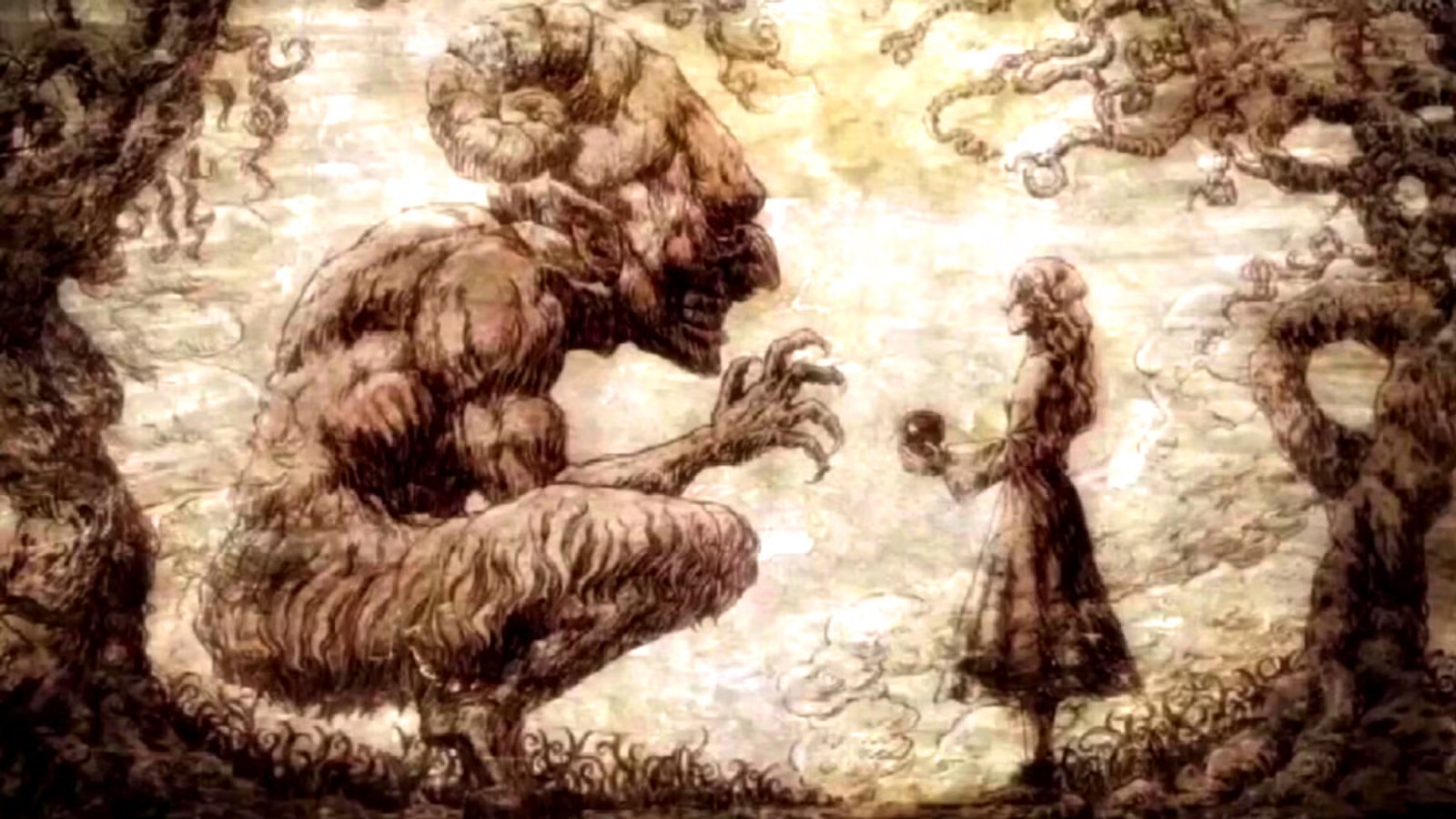
Eventually the technocrats of northwest Europe tire of all the massive migrations and agrarian revanchism and aim to colonize Greenland by destroying Iceland, harvesting the heat from it and transposing it to Greenland. These cataclysmic events are described in excruciating detail and culminate in the awakening of a verdant life force pushing back against humanity’s hubrises. The endeavor awakens or otherwise manifests eldritch beings and select humans are grown into towering grotesqueries to combat them. One substack writer asserts that Mountains, Oceans, Giants is the inspiration for Neon Genesis Evangelion. While I doubt there’s a direct connection, the comparison isn’t off the mark, and I think similar comparisons in vibes could rightfully be made to parts of Akira, Jyu-Oh-Sei, or Attack on Titan.
Written over 100 years ago, many of the technological specifics of Doblin’s epic may feel inexact yet are eerily prescient. Rather than a hard focus on the mechanisms of science, Doblin’s speculative fiction emphasizes the interfaces of nature, man, and his artifices in a way that makes it feel timelessly relevant. In the novel, “Meki-meals,” a synthetic food mostly made of inorganic matter, still needs some component of life in it. Decades before soylent green Doblin is writing about artificial food needing human life churned into the batter. Europeans, after generations of eating the slop become weak. Other groups go off this feed not because of the macabre ingredients, but because they feel like it’s too fake. Man tries to overcome his own nature with science, but ultimately nature catches up in response to man’s change and drags him back down.
The prose is tectonic and vibrant throughout. Just absolutely amazing. Doblin frequently concatenates nouns together without comma or conjunction. This honestly takes some getting used to, but has a thematic purpose. Different objects and concepts bleed into one another, much like the different species towards the end literally fuse.
Lastly, a note on the translation. The print edition of this is abridged. All references to La Ballaeduese and some other characters are removed. The reason for this is to get the reader more quickly to the exciting cataclysms at the end. I obviously disagree with this abridgement, and think the removed sections are important, but the print edition includes notation for the excised fragments, which the translator has available for download on his website (https://beyond-alexanderplatz.com). However, I did also notice a missing sentence from the German that was not notated. Specifically a sentence introducing the neo-Luddite characters Targuniash and Zuklati and connecting them to the Maccabees. It is an aside comment regarding tertiary figures that add little to the text, but the lacuna makes me wonder if anything else is missing. This seems very much a labor of love for Godwin, and he has many translations for Doblin’s other works are there as well, graciously free awaiting a publisher.