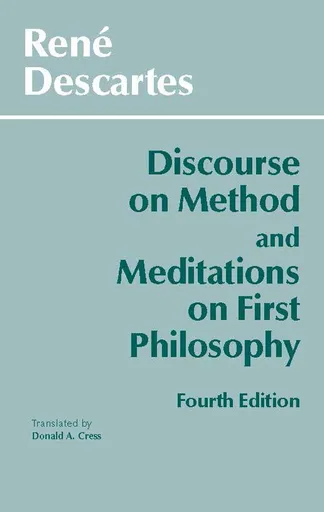
Descartes is for no trifling reason hailed as the father of modern philosophy. The Discourse on the Method appeared in France in 1637 at a precipitous moment of conflict between the awakening Enlightenment and the steadfast scholasticism of the Church. Four years earlier Galileo had been imprisoned for defending heliocentrism, and if any nontraditional philosopher did not want to end up a Galileo (or worse, a Bruno), it would take laborious care not to step on pious toes with a Method designed and destined for toe-stepping. The separation of philosophy from theology is a preferably anesthetized procedure, and Richelieu's Sorbonne was not prone to soporifics. Cartesianism was allowed to eke by, however, and the eventual attempts at suppression came too late.
The Discourse is somewhat maligned when it comes to popular exposition of Descartes, though not as much as the Principles of Philosophy. The Meditations remains the choice of most undergraduate teachers. This is somewhat unfortunate, because Descartes' method has survived much more intact than his metaphysics, and serves as a very able introduction to philosophy in general; I can in truth say I know none better. Though all sorts of refutations and nitpicks can be made, these should not be done, and cannot be done intelligently, until one first proceeds through the method he gives, or a similar one.
The picture of Descartes as the frivolous doubter, as some of his contemporaries chastise him for, should be dispelled in this book; it is harder to see the reasons behind his doubt in the Meditations, because the method is not its subject matter. The picture of him as the simple-minded cogitator, blind to the inaccuracies of his metaphysical system, is also unfair. He is uncovering a new face of philosophy, like Kant did as well, and could only do so within the language of the received tradition. Should we blame him for an inability to describe that face?
No required reading before this, though the interested reader should pick up the Meditations on First Philosophy next.