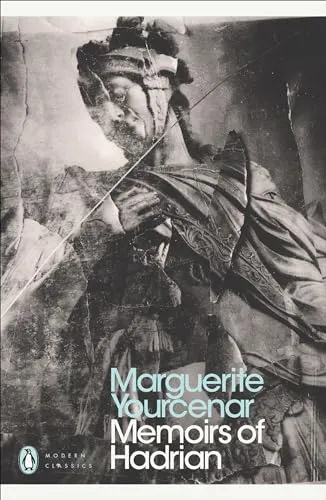


As a historical memoir, this book has to contend with the perennial pitfalls of both historical fiction and memoir — respectively, overdosing on ostentatious period detail, and self-satisfied retrospective airbrushing. I think it overcomes the first of these quite well, especially given the paucity of biographical material Yourcenar has to work with. You do feel transported to that "happy period of more than fourscore years", as Gibbon called it, without getting tangled up in togas. Tromping around the Empire with its peripatetic head honcho, leaving a trail of new towns, monuments and public works in our wake, is fun. But Yourcenar's Hadrian strikes me as more French than Spanish in his disposition; he doesn't have much of a sense of humour and sometimes I found myself wishing he'd loosen up a little. Like many a memoirist, self-deprecation isn't his strong suit. His grief for Antinous is very moving, though (even if Antinous himself remains a cypher), and Hadrian's (and Yourcenar's) affection for this Halcyon era with its air of optimism, general religious tolerance, and comparative lack of senseless mass slaughter is palpable. I realize it isn't cool these days to blame, pace Gibbon, the Christians for the decline and fall, but fuck it, I still do.



Thanks for reminding me to read this, I think I got a copy about six months ago
If you like Hadrian or that period of Roman history it's a must-read. If you don't know much about him you might want to skim the Wiki article first because obviously, he's writing assuming that we're familiar with the main events of his times.
I’m reasonably familiar, excited to see how this stacks up to Williams’ Augustus
Oh man I’ve got to get on that! His other two are pure class.
It just might be my favorite of his, the Maecenas and Julia chapters in particular are top notch