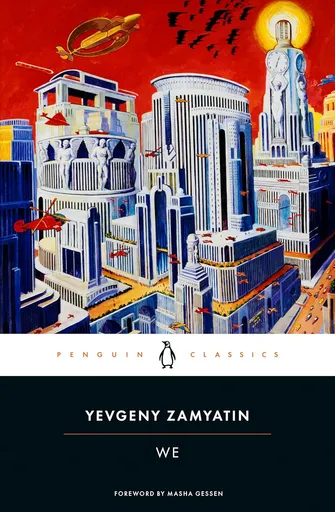

You can get the background information for this book on Wikipedia, it's interesting-ish. The TL;DR : this is a satire that went on to inspire the world of 1984 (and probably Brave New World but Huxley won't tell you that) about a society where scientific management (aka, productive efficiency in the work place) expanded it's scope and encapsulated an entire society - so the society was managed to run as efficient as possible.
As a concept, incredibly prescient. As an executed piece of work... it missed the mark in how that development would actually take place. This is my main gripe with the book.
Zamyatin satirizes a society where efficiency culture is on the face of it ruling peoples lives. They wake up at a specific time, go to bed at a specific time, have a wink-wink 'personal hour' at a specific time, with arrangements for who can have access to whom, etc. It is obviously supposed to be interpreted as a bit absurd, comical, and troubling. Efficiency culture, being the antithesis of human engagement, can't run a society and shouldn't run a work place, I guess, is his argument.
But like - egg on his face, right? Our society is ruled by efficiency culture. How often do you start doing dishes and think "hmm I'd be more productive if I listened to a podcast"? How often do you feel bad for not being as efficient in your hobbies as you should? Sure, I could just be projecting... but I have a hunch I'm not.
So what are we left with, with regards to Zamyatin's satire? He suggests a world where efficiency culture rules the roost, which is obviously on it's face preposterous, and yet here we are, in a world where a more insidious (IMO) version of efficiency culture rules the roost. My only way to make sense of that is to believe that he is considering scientific management/efficiency culture in it's most naive, most immature form - which at the end of the day makes for a fairly uninspired satire, viewed in retrospect...
Divorcing the book form the context of a satire, it's fine. The world-building leaves a bit to be desired. The characters leave a lot to be desired. The conflict feels a bit shallow. The seductress angle for what "brings the MC back to the human light" relies on tropes so comically sexist, it swings around to being almost innocent. The plot is staggered and inconsistent. The writing (while it seems interesting and experimental in it's own way) quickly feels repetitive and grating.
If it felt like Zamyatin had more seriously engaged with how efficiency culture would develop, it would feel like a better satire. Without that, though, it just feels like a kind of bad book. I probably would not recommend.

